Thursday, October 21, 2010

The Sushi Bar (West Lake, Hanoi)


Last night, after losing a battle against inertia, and deciding not to shop, not to cook, and not to stay in my neighborhood where phở cuốn reigns, we decided to indulge ourselves. On this night, that meant going for sushi in West Lake.

There are a few Japanese restaurants in West Lake, but driving past the ones on Xuan Dieu Street, and guessing they were either too pricey or more Vietnamese-Japanese than Japanese-Japanese, we decided to hit Sushi Bar II. In Saigon I ate at Sushi Bar several times, and the service and quality of food was always pretty good. Nothing to get too heated up about, but still good enough to recommend and patronize often enough that the staff came to remember my name. Here in Hanoi, my experience has been much the same: good service and above-average (but not great) sushi. Definitely worth going to, though, especially if you find yourself in West Lake.

Due to the aforementioned inertia, we arrived fashionably late for dinner and found perhaps three other tables with customers. We grabbed seats at the sushi counter, because it’s fun to see the fish up-close and it's interesting to watch sushi chefs ply their trade. (Also, if you’re lucky, and if the sushi chef is feeling generous, you can sometimes score free food.)

Our sushi chefs were friendly and willing to talk all night...

Nothing much to dislike about the interior, unless it's that it's too clean and sparkly...

Although I was in the mood for shochu or sake – both, actually – I settled for a draft beer, then proceeded to order mixed sushi (the “matsu” set) and a vegetable salad (cabbage, tomatoes, cucumber, onion, and what was about three times more mayonnaise than was called for).

Looking at this photo makes me thirsty even now...

Not long after devouring our complimentary starters, we were served a salad that appeared two or three times larger than the menu photo indicated it would be. Don't you just love when that happens? For $1.50, it was a good amount of food, and it took us the entire meal to get through it.

This photo doesn't really show it well, but this was almost a man-vs.-food salad...

Our starter...

The sushi set came with miso soup, but since there were two of us they threw in an extra one for free. When does miso not hit the spot? It certainly did on this night.

Yum...

The sushi set consisted of two pieces of salmon, two pieces of red snapper, one piece of tuna, one of fatty tuna, one red clam, one squid, one sea urchin, one caviar, one shrimp roe, and one salmon roe. All this for U.S. $12.


As I said, the quality of the fish wasn't the best I've had in Hanoi, but it was better than most. I certainly liked the presentation of our food, and the service was good, too.


The caviar and roe sushi, especially, looked almost like jewels.


After piling through our starters, the giant salad, the miso soup, and the matsu sushi set, we decided this wasn't enough food. We took another look at the menu, but it just wasn't doing anything for us. I gazed longingly at the display case of raw fish, then asked if they had salmon skin (sakekawa) on hand to make a maki roll.

Is this not beautiful? I want a display case like this for home...

Luckily, the chef said there was, so I placed an order and turned back to the salad, which still looked like we hadn’t put a dent in it, and continued to attack it. I didn't get a good photo of the salmon skin rolls, but lets just say that it was good enough to deserve its own space on the restaurant's menu. At $2, it was worth asking for.

Yes, the lump of wasabi we were given was a bit large relative to our salmon skin rolls, but no matter.

Our bill ended up totalling $17, but with a 10% discount (I forget the reason) it came out to a very reasonable $15.30. Pretty good for a party of two, I'd say.

Sushi Bar II is located at 1F Syrena Building, Xuan Dieu Street, West Lake. Tel/Fax: (043) 715-3894. Email: sushibar.hn@gmail.com. Web: www.sushibarhanoi.com.

Stumble Upon Toolbar

Friday, October 8, 2010

Some local and imported fun on Truc Bach


It’s Friday in Hanoi. Autumn has not yet come to Vietnam’s capital, and today was sunny and hot. Even though the weekend is on the city’s doorstep, it’s a weekend that’s sure to prove more stressful than other weekends here. Why? Because this is the final weekend (thankfully) of Hanoi’s 1000-year anniversary, a celebration stretching from the 1st through the 10th of October, which has resulted in some of the worst crowds and traffic I’ve ever seen in Vietnam. It’s so bad that I’m trying not to leave my neighborhood, especially in the evening, unless it’s absolutely necessary. So this blog post is one I’m doing of the immediate vicinity around my apartment.

If I squint, or better yet, if it’s a clear day, I can see Nguyen Buoi Street from my balcony. It’s one of the streets that peels off of Tran Vu Street, which circles around much of Truc Bach Lake. There are a couple of small eateries here I’ve come to frequent. One of them is a restaurant that specializes in goose (ngan). It’s not the best goose restaurant I’ve eaten at, but considering how close it is to where I live, I’m happy to come here on occasion. I’m partial to goose with mien noodles, so I always order that here. It comes topped with basil leaves, lemon leaves, bean sprouts, fried onions, and crushed peanuts, and, with a glass of iced tea, it’s a good deal for only 30,000 dong ($1.54) The people who run the restaurant are nice, too, and today I sat at a table with a friendly couple, one of whom was drinking beer and explained to me that beer makes his face turn red. In case I hadn’t understood, he pointed to the red sun-umbrella shading our tables, then pointed to his face, then pointed at his two empty beer bottles, and then laughed. And he was right. His face was red. It was a little scary, in fact.


After lunch I did a full walking loop around Truc Bach Lake, and, lucky me, soon found myself passing the corner of Truc Bach and Thanh Nien streets, which is chock full of ice cream businesses.


Café Số Một lured me with its promise of French ice cream – it certainly didn’t lure me with its architecture – and I stepped inside, seated myself on the second floor, then reseated myself on the third floor when I realized I could look out over the lake from there.


I ordered kem trái duà xiêm (39,000 dong / $2) – vanilla ice cream served in a young coconut and topped with crushed peanuts, candied fruit, dried coconut, and a cookie. It also comes with a complimentary glass of coconut juice, which is a nice touch.


For dinner we had some Japanese friends over. They were kind enough to bring a homemade dinner with them, and I provided refreshments: Tiger beer, Asahi beer, and two types of sake that I’d bought in Japan. I also got to use the sake cups I bought in Kanazawa, which was fun.


Upon returning to Vietnam two weeks ago I gave my Japanese friends some blowfish (fugu) eggs mixed with nukka (the brown husks of rice), and they brought this over, too.


The flavor was very strong and the texture surprising – on the whole, it was sort of like eating creamy blue cheese. But because the flavor was strong, the sake tasted that much better. I thought it might have a numbing effect, too, as fugu I’ve eaten before always has, but this one didn’t. In any case, my friend and I polished off about 1 1/2 bottles of sake, which I really didn’t feel, but I think he did because at one point he started yelling English obscenities from my balcony and at another point he began burning giant mosquito-like bugs on my couch with his cigarette lighter. (For the record, I condoned the former but not the latter…)


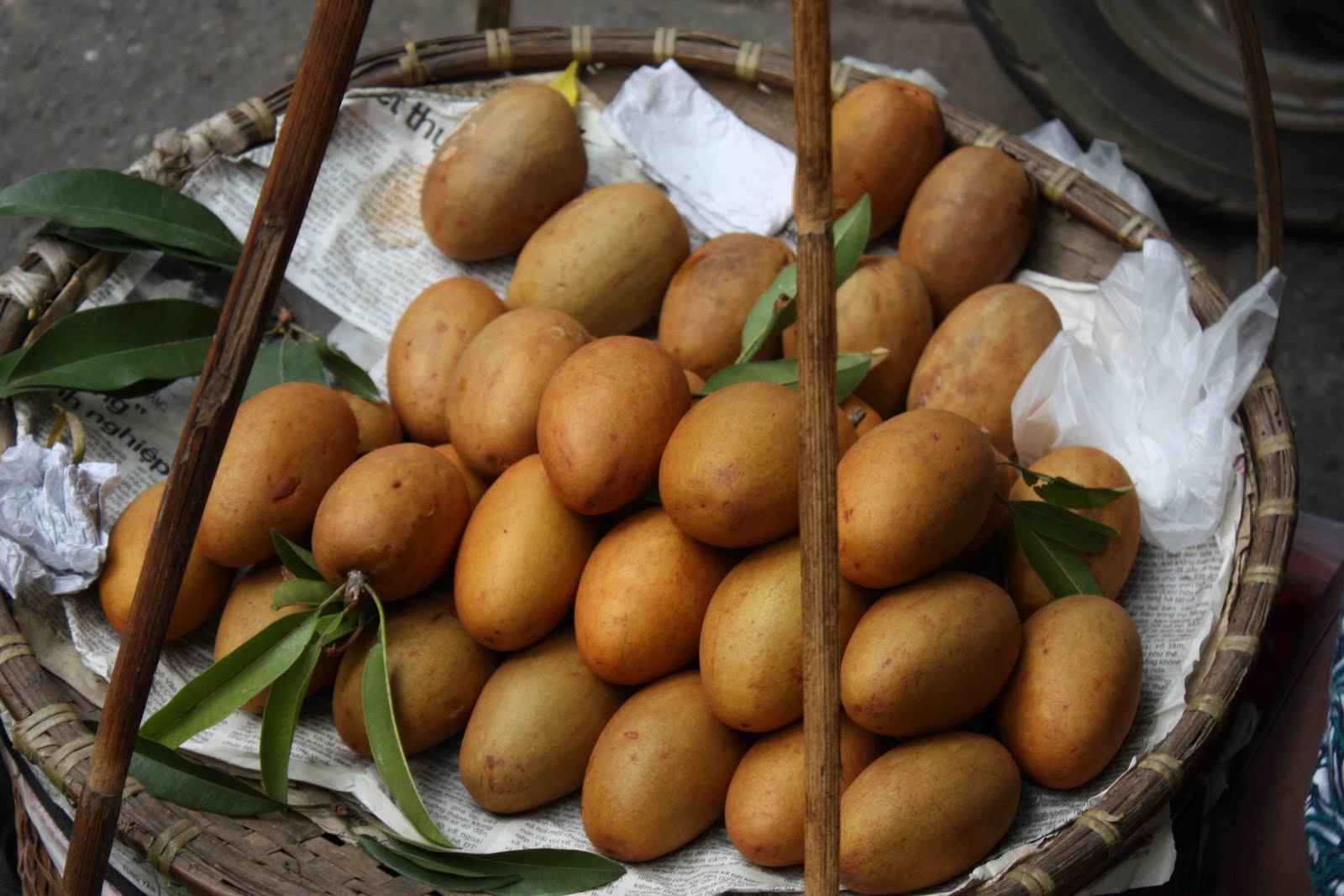
I’ve included two more photos, too, somewhat randomly. For anyone wondering what a sapuche is, it’s the fruit piled up in the basket in the photo below. In Vietnamese it’s often called hồng xiêm. Why do I use this name for my blog? Because I was half-addicted to this fruit when I lived in Bien Hoa 16 years ago and the name stuck in my mind. Somehow, though, I don't really like the fruit that much anymore...


Also, just in case people wonder if I ever eat American food in Vietnam, the answer is generally no…but not invariably no. Here’s a photo of two bacon cheeseburgers I made the other night.


Sometimes, I just have to have a good bacon cheeseburger (and these were good). Hey, am I alone in this? I didn't think so...

Stumble Upon Toolbar

Thursday, September 30, 2010

Copping An Eel in Hanoi


Last night, suffering from a lack of ideas for dinner, it suddenly popped into my head, as if I were in a parallel universe directed by Wang Kar Wai, that I was in the mood for eel. When this happens (more often than you might think), I have an easy solution – make my way about five blocks to the unimaginatively named “Nha Hang 34 Yen Ninh,” which can be found – where else? – at 34 Yen Ninh Street.

This place is a hole inside a hole in the wall. The entrance is not at all inviting, nor does it inspire much confidence, although the kitchen window, which faces the street, does offer one, as one parks their motorbike on the curb in front, a whiff of eel magic.

Although the photo here doesn’t show it, the place was absolutely packed when we entered. We were led to a single table at the back, beneath a TV screen showing a Spanish soccer match, and around which a little girl in glasses kept walking, staring at me all the while, saying “hello” in English but not replying to me when I tried to talk to her in English or Vietnamese. She was pretty funny, actually. Admittedly, it might have been the effect of her coke-bottle glasses.


We ended up ordering cháo lươn (eel porridge), which was quite satisfying – the eel was meaty and abundant, and the porridge thick enough to stay on my spoon. It was the first time in perhaps 12 years that I had cháo lươn, and it was different from what I sometimes had, and grew to love, in Biên Hoà before even that.


We also ordered chả lươn, which is basically eel deep-fried with lemongrass, and served with a kind of mint leaf and fish sauce-based dipping sauce, which in turn had red chili sauce at the bottom. This is probably my favorite dish at this restaurant, at which I’ve eaten twice. I love the combination of eel and lemongrass, and these balls of chả are like sponges when dunked into the sauce.


Our third and final dish was bún noodles served with a steaming hot pot of tofu, West Lake snails, banana, and a dark leafy vegetable. The soup was fairly hearty and tasted a bit of Chinese five-spice. I loved the combination of ingredients, and bún is the perfect choice to go with it.


The cost of all three dishes, plus two glasses of iced tea, came to 121,000 dong, which the owner was kind enough to round down to 120,000 ($6.15).

We left feeling fairly full (including my wallet, thankfully), but as the evening was young, and we wanted fruit for dessert, we headed up Yen Phu Street to a small hotel with a two-story café set on top of it. The café, Lang Bac, is pretty interesting – the first floor is basically a glassed-in room showing films, with fully reclined chairs (sort of like thick mats with short backs to them) spaced evenly throughout; perfect for couples who wish to lie down together and either watch the movie or canoodle, basically in open view of everyone else. We climbed to the third floor, which also had a glassed-in movie room, but also had a spacious terrace overlooking West Lake and the Hanoi Club Hotel (the lit-up building on the right in the photo), and ordered hoa quả dầm with a mix of yoghurt and sweetened condensed milk.


At 35,000 dong ($1.79), that’s about twice the price of what you’d pay for it almost anywhere else in Hanoi, but this was a great mound of cut-up fruit mixed together with who-knows-what – it was too dark to see. The flash of my camera showed what appeared to be strawberry sauce on top of what was already pretty incredible, and I have to say, this was truly outstanding for such a simple dessert. It was half-healthy, half-pure-decadence. I have a feeling I’m going to be coming here often, until I decide I’m up to duplicating this in my apartment. But at 35,000 dong, including a view of West Lake, it’s sort of worth just coming here and letting them do all the work instead.


Lang Bac Café is on 52 Yen Phu Street and is open from 9 a.m. to 10:30 p.m. every day. Email: langbaccoffee@gmail.com.


Stumble Upon Toolbar

Saturday, September 25, 2010

Day Visit to Bat Trang Pottery Village


Last Saturday, my first since getting back to Japan, I decided to visit Bat Trang Pottery Village on the outskirts of Hanoi. I’d been here twice before – once in the summer of 1994, and once in the winter of 1997 – and remembered it as being quite different from what I found on this visit. While Bat Trang is still interesting and worth spending time wandering its quiet, tree-lined back streets – avoid the commercial center as much as possible, unless you’re there to buy kitschy souvenirs – it’s become a bit of a maze and finding high-quality pottery is not necessarily an easy task.

After crossing Long Bien Bridge into Gia Lam and then winding along dusty, multi-layered roads full of construction and reckless car drivers, we found our way to Bat Trang village, panting and wheezing, and parked across the street from the entrance to the main pottery market. We entered the market, ignoring the touts asking us to pay 50,000 dong to watch pottery demonstrations – we were aware that you needn’t pay money to see this, as the back streets offered free access to many families creating pottery in their homes – and skimmed the various sale-shelves of pottery and ceramics, which were incredibly cheap but not of particularly high quality. Still, the sheer number of pieces for sale was impressive, and it was fun wandering around.


After about 45 minutes we exited the market and found ourselves in a charming alley. Bat Trang is 1000 years old, and many of its ancients streets have been preserved. You won’t find 1000 year-old homes or artifacts of any kind, but everything here is old – perhaps the oldest thing you’ll find is the physical layout of these crumbly, narrow back streets.

We quickly happened upon a wood-and-brick house that looked as if it might collapse under the next storm that rolled through. In the window, which was barred, were several children painting at a table. We entered the very weathered, sideways-leaning door and found a woman teaching a handful of students how to spin a stone wheel and fashion objects out of clay.


Behind the students was the table we’d seen through the window. They had bought (or rather, their parents had bought them) clay figures the teacher had made but not yet painted in. For 10,000 dong one could make pottery under the teacher’s guidance, and for another 5000 dong you could paint it however you’d like.


When the students had finished making their pottery, the teacher took the objects outside and under a low, caved-in roof she placed them before a small electrical heater (whose wires she had to figure out first). At the same time this small heater was pumping out hot air, a fire beneath the board on which the objects sat also contributed to quicker drying.


We watched this for a while, then moved further down the street.


While not every house here is involved in making pottery, it’s still fairly common to find yards filled with objects at various stages of completion.


One even finds steps used for drying vessels under the sun.


Loading up (or down) a motorbike with pieces to sell at different stores.

We found a few people in front of a house transporting clay inside, and we asked if it was okay to observe how the family made pottery. In fact, although the pottery studio was family-run, it had a staff comprised of several non-family members, too. It was fascinating to see the process firsthand – quite different from what I saw in Kanazawa, Japan, two weeks earlier.


Each woman paints about six vessels per hour. It's nothing short of amazing to watch them fill in the white space with various images.


The house is open like this to allow the heat from the kiln, which is just to the left of this photo, to pass through.

By the time we’d finished, the heat was unbearable and we went off to find some place to eat and re-hydrate ourselves. We entered a bia hoi and asked for an air-conditioned room, but the room was a storeroom, and although the owner began moving everything outside so we could eat there, we told him we’d sit by one of the restaurant fans instead to cool down. We ended up ordering a plate of cut cucumbers (40,000 dong) that came with a dipping sauce of salt, pepper, chilies, and lemon juice, and also a dish (60,000 dong) of boiled lamb and an herb called lá ngổ that was simultaneously bitter and sour and very good, all of it sprinkled with sesame seeds and served with a mildly flavored dipping sauce made from fermented soy beans, ginger, and sugar. This was a surprisingly satisfying lunch, though I definitely could have done without the pieces of skin, many of which needed a few swipes of my Mach 3 razor.


Overall the trip was a nice break from Hanoi, but coming here on such a hot day, and on a weekend, probably wasn’t the best idea. One can arrange tours to Bat Trang through any number of tour agencies in Hanoi, or, if you have your own motorbike, you can just find the fairly well-marked signs to Bat Trang. Finding good ceramics and pottery takes some doing, and wandering through the older part of the village is a good way to discover them. The ceramics prices are negotiable, and you can often get a discount between 10-20% in the market. Make sure to look each piece over before buying, as small flaws are fairly common.

These two I particularly liked. The styles are based on an old type of ceramics that Bat Trang once specialized in.

This guy was checking me out in front of a store as we left Bat Trang.

Stumble Upon Toolbar