Saturday, February 26, 2011

My Second Day in Kratie, Cambodia


Today I woke up, of my own volition, at 5:30 to see Kratie Market come to life. I also thought, so early in the morning, I might get an up-close view of the “fish market” on the dirt streets behind the main market building.

Arriving before 6—it was only a three-minute walk from my hotel—I found myself there before most of the market vendors. It was too dark yet to take photos without a flash, so I wandered around the few square blocks that the market occupies (or, rather, spills over into), exchanged smiles and hellos with a number of people and soaked up the local morning culture that presented itself to me.


At about 6:30 the sun was up and brightening, and the fishmongers were fairly well set-up.


The Mekong River used to boast the second most productive fisheries in the world, behind only the Amazon River, but this is starting to change.


Because of unregulated increases in fish catches in the late 1990s and early 2000s—due in part to illegal fishing methods such as dynamiting and electrocuting parts of the river to kill whatever life is caught in its range (including dolphins)—fewer and fewer fish are being seen around Kratie.


I’ve been told of how dolphins and giant catfish (250 kg in some cases) were often seen from the riverbank in Kratie, and how one could throw a net into the river and nearly be guaranteed a minute later to reel in a full catch. Now, there are only 100 dolphins left in all of Cambodia, the giant catfish is on the verge of extinction, and fish catches are much lower now than in the recent past.


Still, the variety of fish available at the market, which is small, impressed me. I’m only including here about half the different kinds of fish I took photos of at the market.


Closer to the main market area, which I was also told is full of Vietnamese vendors (though I only heard Khmer spoken), there are also a number of flower sellers. Below are two women busy folding the petals of bright pink lotus flowers.


It’s almost startling to see how many young people live in Kratie—there’s been a big baby boom since the Cambodian conflict ended—and as I walked through the market I was assailed by shouts of “hello” from quite a few children. However, I also made at least two kids cry when I offered my own hellos and waved at them…


I spent much of the rest of the morning walking through the central part of Kratie and the paved road along the Mekong River. This doesn’t take a long time…unless you stop a lot to take photos.


I circled back to the river road by my hotel and passed by Wat Kratie, which is under construction and seems to have more dogs on the premises than monks or worshippers.


Early in the morning one can see monks, usually in groups of three, walk in a line through the streets begging for alms. As you can see in the photo below, people take off their shoes before offering them food.


The paved road along the river is lined with impressive rows of shade-giving trees. I’m guessing they were planted by the French in colonial times, as they also tower over old French colonial buildings that are now used by the local government and various NGOs.


Other trees are simply impressive, though they don’t look as if they were planted and cared for by people.


It’s amazing to see some of the houses perched on the riverbank. I wouldn’t want to walk to the back of some of these homes, which don’t look as if they can withstand any more weight than they currently hold.


It’s amazing, too, to see how people make use of the river for so many different things. In the photo below, three men are bathing horses.


I passed a few schools in central Kratie, too, and my wanderings were followed by a hundred children’s voices calling out “hello” all at once.


Another striking feature about Kratie is the local architecture.


The homes are almost universally made of wood (which is treated with “swamp water” so that it can withstand the climate’s heat and moisture) and built upon stilts.


The Mekong River usually doesn’t flood in Kratie, though it did, I was told, in 1999, and during heavy rains the water can come up to one’s waist (as it often does in many Hanoi and Saigon streets).


On the way back to my hotel I came across an old tree with a small altar built into its side. For some reason the old milk cans used to hold incense had a picture of a blond boy: My Boy brand sweetened condensed milk. I couldn’t help but take a photo of it.


The day ended, as it always seems to, with an amazing sunset over the Mekong River.

Stumble Upon Toolbar

Friday, February 25, 2011

Trip to Kratie & River Dolphins & Fried Tarantulas!

By the way, that's an Irrawaddy River Dolphin in the lower left of the photo.

Whenever I travel, and blog about my travels, I feel like I always begin with something along the lines of: “I got up ridiculously early this morning” or “A racket from god knows where woke me up at 2:30 a.m. and I couldn’t get back to sleep.” Well, in Phnom Penh, noise from somewhere—the street, I presume, but also hotel doors somewhere above or below me—woke me up at about 3 a.m. and I couldn’t get asleep again before my 5:30 alarm went off. I didn’t bother with breakfast, but had a tuk-tuk take me directly to a bus station where I caught a Sorya bus—a big one, with assigned seats and everything—to Kratie. I didn’t take any photos of scenery along the way, in part because I was in an aisle seat and partly, too, because the windows were all tinted brown (or maybe that was just dust from the highways that can no longer be scrubbed off).

I recommend Sorya bus company for the trip to Kratie, though it's a fair bit slower than a mini-van.

The bus ride was meant to be somewhere between five to eight hours. The bus driver told me five when I got on board, my hotel in Phnom Penh told me six, and the hotel in Kratie guessed it would take eight. Well, it took eight. I didn’t eat until arriving in Kratie, which was probably a good thing in the end, because at the two rest stops we visited, neither of the bathrooms were the least bit useable. Though I used them both times. Somehow.


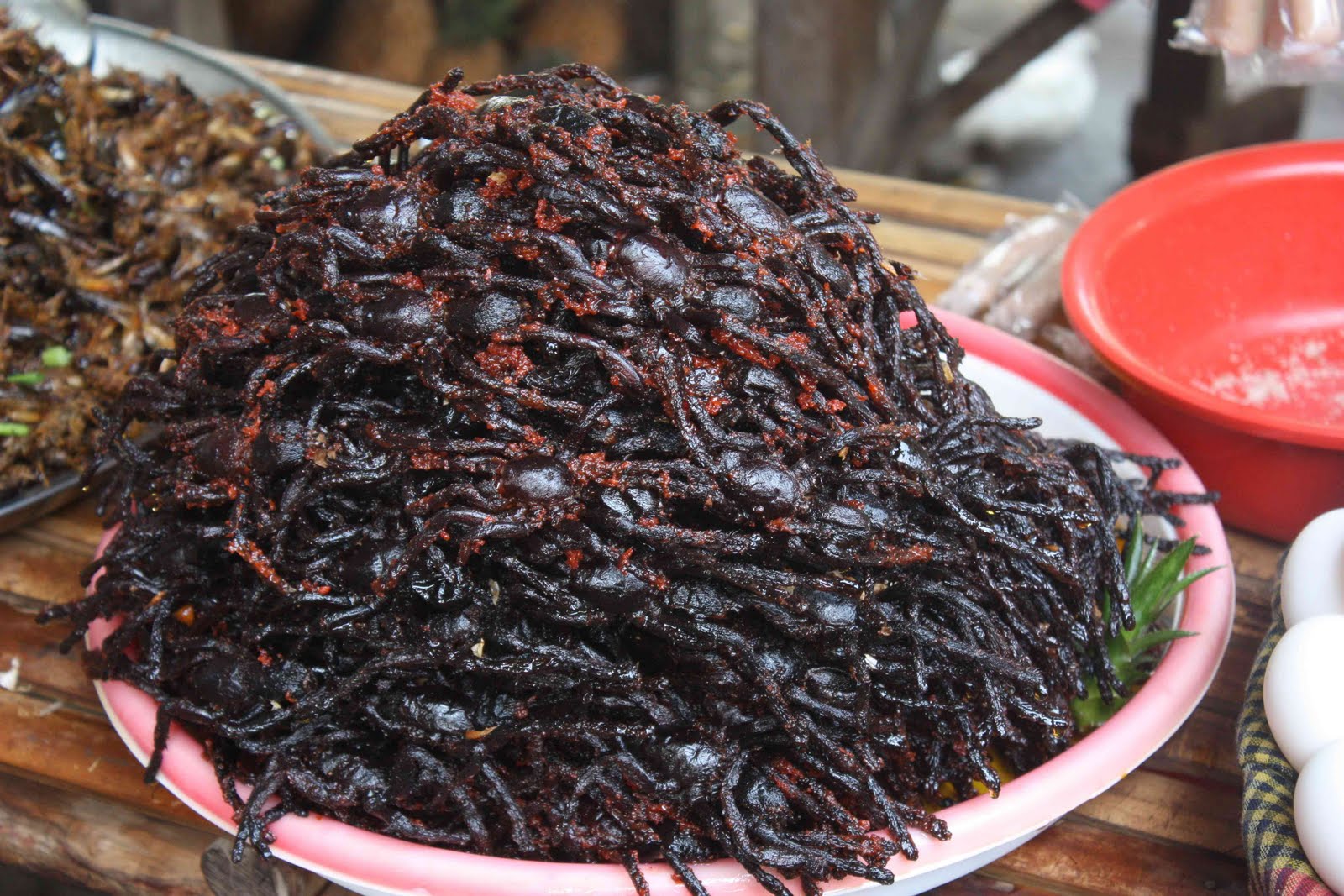
At the first rest stop, the highlight had to be the fried, spicy tarantulas. In order to draw tourists closer to their stalls, the vendors even kept buckets filled with live tarantulas, along with a long piece of straw in case you wanted to poke at them or perhaps lift one onto your hand or, even better, the shoulder of someone who doesn’t even realize the tarantulas are there.

Wouldn't it just suck to drop an earring or a cell phone in that bucket?

I was told that the tarantulas are collected from local rice paddies, and that they have a sweet taste to them. I was tempted to try one—a leg, at least, if not an abdomen or head—but that long bus ride gave me pause. The Cambodian guy next to me bought a few, though, and kept feeding them to his Caucasian girlfriend while she talked on the phone. I was impressed.

Spicy, fried tarantulas, anyone?

They also had fried, spicy crickets, but they lacked the "star power," if you will, of a bucket of live tarantulas.


At around 3 p.m. we pulled into Kratie, and I walked about 200 meters from the bus company office to my hotel.

Part of the river promenade in Kratie, right across from most of the guesthouses.
Coconuts all prettied up for drinking.
As soon as I checked in I was asked if I wanted to see the dolphins at around sun-down, so I said sure, and went upstairs for thirty minutes to relax and get ready.


This tells the story about how a young woman was turned into a river dolphin. At first I thought it was a warning to people about giant people-eating snakes, and what to do in case someone you're with gets swallowed.
The Irrawaddy dolphins don’t actually live in the river around Kratie, but in a place called Kampi, which is about a twenty-minute tuk-tuk ride from where I’m staying. I shared the ride with another hotel guest, and the total cost of the ride and the one-hour boat tour was $15.

At the entrance to the Kampi dolphin pools.


In Cambodia, the Irrawaddy dolphins are critically endangered. There used to be more than a thousand of them, and my guesthouse owner told me that as a boy he used to swim with them in the stretch of river skirting the town. Now, however, there are only 25 left in Kampi, and only 100 left in all of Cambodia (according to my boat guide; I’ve read that there are far fewer).


Loons flying past an egret perched on a rock.

I couldn’t believe how many we happened to see, though. If there are 25 in Kampi, I feel like we must have seen them all! They were very active, and while they probably changed locations during their feeding time, we saw them in quite a few different places. They also had different colorings, it seemed. Some appeared to be gray, while others appeared almost black. Perhaps it was just the light, though some of my photos in this post kind of show the differences in color among the dolphins.


There were also a great number of birds in Kampi, and hundreds if not thousands of loons flew over the water, many just skimming the surface. The area is an important habitat for many kinds migratory bird species.


Some Cambodian monks were there to get in on the dolphin photography action.


We got back at a little after six, at which time I immediately went for dinner—my first real food of the day. I chose a place that supposedly had a large selection of Khmer dishes, but the menu made it hard to know what was available.


I went with “fried fish ginger” and white rice, and it was extremely good. I like anything marinated in fish sauce and sugar and then fried, and whatever else they did to make this dish, it had all the flavors I’ve come to love about Cambodian food. It cost about $4.50, which seemed a little pricey, but I’m finding that’s about right for your typical tourist restaurant. The rice and draft beer were another $1.50.


Mekong Restaurant is on the corner of Rue Preah Sura Marit Road and Rue No. 9. They have an English menu, and the owner’s family speaks a fair bit of English.

Stumble Upon Toolbar