
Wakasa Bay, Obama City, Fukui.
Last weekend, in addition to visiting Eiheiji, I traveled to
Obama City on the Japan Coast of Fukui prefecture. It seemed easy enough to get
there by train, and the information I found about Obama-shi on the Internet
made it sound like an interesting destination. For example, Obama is where
North Korean agents abducted Japanese citizens 34 years ago. And several centuries ago, Obama was a passing-through point for people traveling between China
and Kyoto (Japan’s old capital). It also holds a water carrying festival
(Omizuokuri Matsuri) every March that’s been going on for more than 1200
years.
I departed from Fukui station on the Thunderbird Express at around 10 a.m. on Saturday
morning, and then transferred at Tsuruga for a JR line to Obama. From Tsuruga to Obama, there’s only local train service and Obama is the 16th stop on the
line. The train had only two cars, and the tracks cut through a little-populated countryside, with occasional views of the ocean near the end of the
40-minute trip. The fall foliage made the trip picturesque, though there didn’t seem much worth stopping for.
Obama station is tiny, but it does have a tourist
information office inside and offers a variety of maps, some of which are in English. From
there, it’s about a 15-minute walk to the bay, but there are some interesting
places to visit along the way. One place I stopped at was Fisherman’s Wharf. If the weather had been better I would have taken the Sotomo Scenic Cruise, which leaves from the wharf for what it widely regarded as the Japan Sea’s most scenic tour, but instead I spent more time at the municipal fish
market.

As you can see by the painting on one of the market’s walls, the city
has embraced Barack Obama––or at least images of him that might bring in
customers. In this painting, he’s wearing a traditional conical hat and
fisherman’s coat, and holding a package of one of Fukui’s specialties: heshiko
(saba that has been pickled in nuka, or rice bran). I have no idea what Obama’s pointing at, but
whatever it is he seems as happy as the giant cat behind him.
The fish market itself was smaller than the building might have
you guess (though it’s probably much busier and livelier in the early morning),
and since winter is crab season there were plenty of crabs on hand. There were
plenty of freshly caught fish and shellfish, too, along with fish drying on
racks outside.


Once at the bay—or one small corner of it—which was besieged by hawks hungry for fishermen’s throwaways, it was time to fill my belly with some of the seafood I’d seen at the
fish market. With this in mind, I headed for a beautiful little restaurant called Hamano Shiki.


For only ¥1150 (less than $14) I ordered fried saba, which came with a small salad, pickled veggies, miso soup, white rice, green tea, and a citrus jelly dessert.

Directly across from the restaurant is
Miketsukuni Wakasa Obama Food Cultural Center, a museum devoted to Japanese
food culture, and there are numerous displays on the first floor of Japanese
food according to season and also by historical period.


Amazingly, the food of
old Japan hasn’t changed much over time, so when we eat a traditional Japanese
meal we also delve back gustatorily into Japan’s long culinary history.
From there, it was another ten or fifteen minutes by foot to
get to the Sanchomachi district of Obama, which is known for its well-preserved
homes and buildings dating to medieval times when the area was a red-light
district.


Perhaps I missed the turnoff to the main street with all these old
houses, but what I found was quite limited and virtually nothing was open. What
I saw was interesting to me, but I was able to pass through the area in
about 10 minutes. Supposedly there are a few geisha houses here and also
restaurants that employ geishas to entertain customers. But I didn’t see
anything like this.
There was a freezing rain falling by that point, so I went
and found a café where I ordered hot cocoa and sat by an electric heater. At
around 4 p.m. I asked the café owner to call a taxi, and from there it was
about 15 minutes to Itaya Ryokan, which is set in a quiet cove of Wakasa Bay.

This is the view from my room.
The main building is made of wood and has four stories (beside it is a three-story annex), with nine rooms. The building used to belong to the village headman during the Edo period (1603-1868), and much of its original architecture remains. It also has an Edo-period storehouse and garden, a beachfront, and onsens.

This was the front room across from the registration desk. Big groups have dinner here, and it leads into the inn's spacious garden.

A giant wood carving of bears.

Upon check-in I was served a sweet and salty plum and hot green tea with plum mush at the bottom.

This is the breakfast room. It’s meant to recreate the feeling of being on a boat.

It may look like a jail, but that’s just the sliding wooden door at the entry to the room.
The onsen looks over the bay, where numerous blowfish (fugu) nets have been laid. One of the hot baths had a
Jacuzzi, and there is also a sauna behind where I took the picture below. The onsen were open 24 hours,
too, and I went back there nice and early on Sunday to watch the sun rise.

Dinner was served in the room, and it was a full course of crab
from the Sea of Japan. The appetizer was heshiko, mountain vegetables, crab roe, salted and packed
roe, pressed sea bream sushi, and fish cake slices.

After that I tucked into fresh, already cracked-open boiled crab.

Sashimi, including crab sashimi, followed.

Minced crab meat with a fried egg came afterward.

And finally, a crab hotpot with tofu, mushrooms, watercress, and leeks.
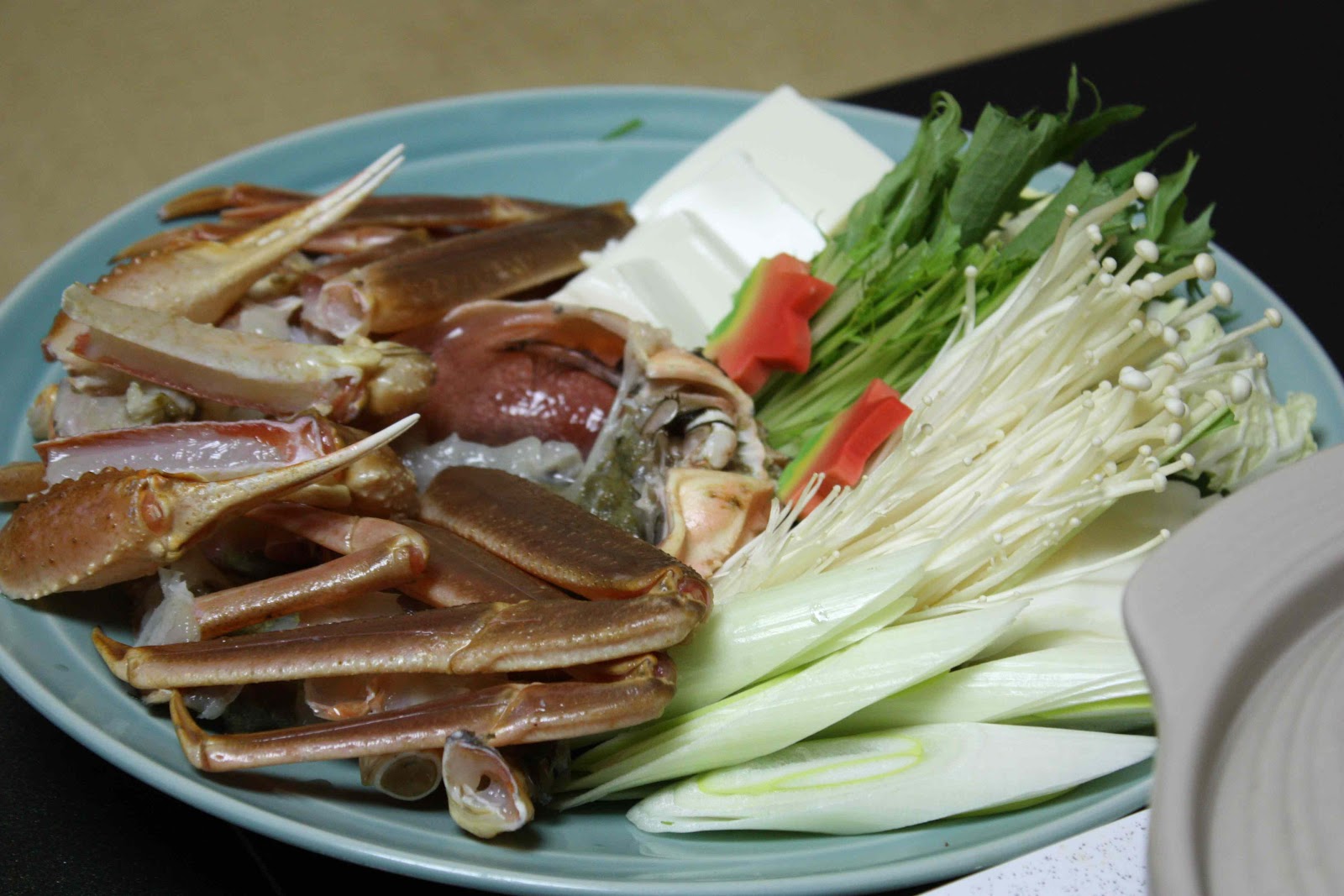
With a dessert of red bean and cinnamon jelly.

Somehow, in the morning, I made room for this healthy
breakfast.

Before leaving and returning to Fukui, I took advantage of
the rare appearance of the sun and walked around the premises. There were
numerous cats in the alleys and even around the beach, including this guy in
the photo below who complained vociferously as I approached with my camera.

Quite a few people could be seen fishing on the pier to one
side of the beach, and in warmer weather there are small rowboats one can use
to explore the bay.


For anyone interested in staying at this
traditional Japanese inn, Itaya’s website is here: http://www.itaya.biz. It’s all in Japanese, but the photos are nice!


 Posts
Posts


