Wednesday, February 23, 2011

On My Way to Cambodia: Hanoi to Chau Doc


As you can see from the photo above, I woke up to rain and fog in Hanoi. It was little bother, though, as I would soon be on a flight to Ho Chi Minh City, which is smack in the middle of the dry season now, and by the end of the day would reach Chau Doc, a charming little town on the border with Cambodia.

I took my first-ever flight with Air Mekong, whose flight schedule was more convenient for me than that of Vietnam Air. The ticket was also $35 cheaper. I found the seat to be small, but otherwise the flight was smooth going. They also fed me, which made me happy.

I got into HCMC at 11:35, then grabbed a taxi to Mien Tay bus station. The taxi driver, I soon discovered, was from Hanoi, though he’d moved to HCMC more than 20 years ago. He had nothing good to say about life in Hanoi, and he’d recently gone back to celebrate Tet with the family he still has there. He said people in Hanoi only think about money, that they cheat everyone constantly, and he also complained about how bad the coffee there is. As if to prove this to me, he pulled up to the side of the road, parked, and left the taxi idling. I saw him walk to a sidewalk coffee stand, then return with two large, sealed plastic cups full of iced coffee.


He handed me one and asked if it was better than the coffee in Hanoi. I took a sip, swooned, and nodded while still sucking on the straw. I’ve never had a taxi driver treat me to a coffee while in the middle of a fare. It’s nice that I can still be surprised after almost seven years here.


When I got to Ben Xe Mien Tay I somehow figured out how to get a bus to Chau Doc within the hour. (Thank god I speak Vietnamese. I pity the poor souls who go there expecting to use English, or expecting to find any sort of organized system to locate information.)


I ended up buying a ticket to Chau Doc on Hung Cuong lines. I paid 105,000 dong ($5.03) for the ticket, and had two seats all to myself.


It was nice to have access to a window so I could take photos of the journey, though it turned out that I was on the “less photogenic side” of the bus, as much of the river scenery, and a town with an endless series of kilns, was on the other side of the aisle (the right side).


It didn’t take long for the city to give way to the countryside, though that doesn’t mean that the roads were ever empty.


The vividly-green rice paddies gradually lost their color as we traveled farther south, and we came upon more and more bridges—over small rivers, tributaries, and streams—as we made our way deeper into the Mekong Delta.


We stopped at a traveler’s kiosk about two hours into our journey. I made use of the passably-clean restroom and then bought one of the best sandwiches I’ve had in Vietnam.
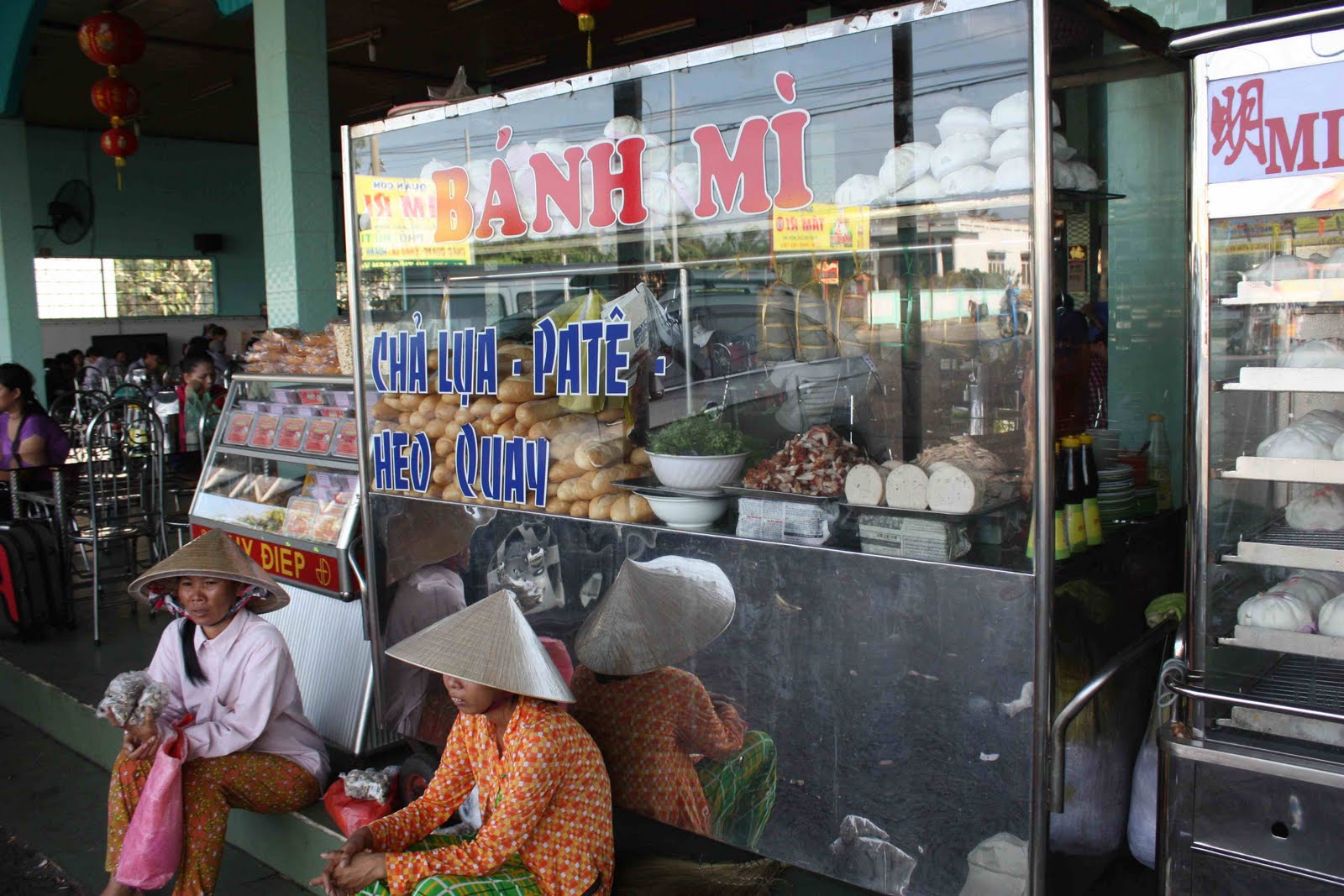


The heo quay, or crispy pork, was beyond excellent, and I wish I’d bought two of them though I was full after the one I ate.


We kept going south, and waterways became more prevalent. So did areas of construction.


Somehow I felt nostalgic for the Vietnam I knew a decade or longer before. The towns here are less developed than in Hanoi and HCMC—the towns here are nothing like Hanoi, however—and I felt a bit as if I were back in the past. It felt good. It felt really good.


I think this partly had to do with the heat, but it also had to with the types of things I saw along the roads—the waterways, the less busy streets, the greater feeling of quietude, the smell of what nature one finds here, an indescribable quality about the light in the south of the country, the architectural styles in the countryside and small towns…I could go on.


At one point, as the sun was beginning to fade, we had to board a ferry to cross a narrow river.


Soon after that we found ourselves entering the city of Long Xuyen, which was strikingly urban, and vibrant, after the small towns and rural villages we’d passed through.


Eventually it grew dark enough that I could no longer take photos from the back of a moving bus—everything ended up blurry. At about 7 p.m. we arrived in Chau Doc. I immediately bought a ticket for boat ride up the Bassac and Mekong rivers to Phnom Penh. I used the Blue Cruiser company and bought an express ticket for $50. The ride was meant to take three hours. However, it took a little more than five hours, and we were passed along the way by two of the “normal” boats that only cost $22. (Yes, I kicked myself repeatedly for wasting $28 just to save a little time.)


I stayed at the Trung Nguyen Hotel (no relation to the coffee company), where I paid $12 a night for a nice little room facing the market.


For good local food, as I requested, they recommend a place called Truong Van, which was a block-and-a-half away. There were about ten backpackers there, and three or four Vietnamese, but I was too tired to go anywhere else and so I plopped down and ordered fried fish (ca hong) and veggies (which turned out to be a salad of raw greens and cucumbers). With a beer, it ended up costing me 60,000 dong ($3).


The night wouldn’t have been complete without some good old southern che, so I found a che buoi (pomello che) stand and for 9000 dong ($.43) I satisfied that craving.


After that, I went to bed and crashed.


By the way, sorry the photos aren’t so good; most were taken from the back of a moving bus.

Stumble Upon Toolbar

Tuesday, February 22, 2011

Visiting Temples in Hanoi During Tet (Part 2)


Following our trip to Phu Tay Ho, we continued around West Lake to our next destination: Van Nien Pagoda.


What I find most beautiful about this temple, which is set behind a lantern-strewn stone wall and wooden gate on the western shore of the lake, is the Buddha statue sitting in the shade of a giant tree. The image of the statue is reminiscent of the historical Buddha meditating beneath a Bodhi Tree.


This pagoda is often empty, and the stillness and quiet found in the large back courtyard is worth seeking in Hanoi.


There are several interesting buildings here that are open to visitors, though one of them, as well as what appeared to be a living quarters, were presumably only for the use of the monks who live on and maintain the premises. I have no idea what architectural styles some of the buildings follow, but two of the larger ones, which happen to face each other across the courtyard, have high, narrow windows along the outer wall of what could almost be a boat.


There are also quite a number of flowering plants here, though once Tet is firmly past its time I expect many of them to disappear.


The inside of the pagoda’s main building was incredibly bright and colorful. Tall, lacquered guardian deities flanked a large prayer structure in which numerous bodhisattvas sat or stood. Offerings, especially for Tet, were plentiful and included stacks of fruits, flower bouquets, canned beer and soft drinks, porcelain bottles of sake, boxes of tea and candies, as well as votive prayers and various objects to be burned for the use in the afterlife.


Next door to the room pictured above were more altars and offerings, including this giant mountain of ginger, limes, red chilies, tree branches, dried flowers, garlic bulbs, and other items (see photo below).


Outside the pagoda was a wooden prayer house inscribed with Chinese lettering on its sides. In front of it stood a tall cast-iron urn in which paper offerings were burned.


I picked up the long wooden fire-poker and tested the depth of the ashes. They must have gone a meter deep, and when I put the poker down my hand was covered with black ash. I wasn’t expecting that. Good thing I was wearing jeans and have a washing machine at home…


As you can see, the urn was decorated with carved dragons like the one pictured below. I’m not exactly sure what it represents, or why its right foot is raised in the air (maybe that foot gets hot with a fire underneath it), but maybe I can ask one of the monks the next time I visit.


From Van Nien Pagoda it was only a five-minute drive (the way I drive, which is carefully) to Chua Tao Sach. There had recently been a large fire here, but I couldn’t see much evidence of anything having been burned down. With Tet on hand, too, the temple was made more colorful by all kinds of flowers and potted kumquat trees.


This temple, too, was quiet and uncrowded. After Phu Tay Ho, it was a relief to find that we had the temple grounds mostly to ourselves. We enjoyed being able to explore the temple freely and devote more time to peaceful contemplation of the various interesting things we found here.


There were a number of tastefully designed dioramas, including one resembling a watery cave in which the Buddha sits meditating and two beautiful women stand guard at the cave’s entrance. Where this bizarre rock formation came from is anyone’s guess, but it was impressive.


Tao Sach Temple also boats a reclining Buddha in the entrance of the temple’s main prayer hall. It’s sandwiched between two giant, colorfully painted urns.


The elaborate woodwork of the building’s doors and roof is also worth checking out.


Beyond the compound’s main building, in a patch of rubble (perhaps where the recent fire had been) between a small cemetery and the monk’s herb garden, I found an interesting, makeshift-like structure for people to burn various paper offerings.


I suppose it’s not much to look at, but I must admit that I enjoyed the smell of whatever was inside smoldering – sandalwood incense, possibly, among other things – and thought there was something vaguely wabi-sabi about the open brick altar.


I get easily distracted in Vietnam because there’s just so much activity everywhere. So when I saw some fuzzy puppies lying nearby, I pulled away the Styrofoam they were gnawing on, sopping with dog saliva, and tried to play with them. They bounded after each other, totally forgetting about me in an instant.


Back near the entrance, in a kind of storage area and mini-library within the temple, a young woman was selling medicinal alcohol made in the highland town of Tay Nguyen.


She let us sample some, as I thought a bottle might make a good gift later, but it was pretty vile stuff: vodka mixed with Chinese medicinal herbs, which I thought tasted a lot like licorice, only more bitter.


On our way out I snapped a photo of one of the old women volunteering for the temple. She busted me taking her picture, and told me there was nothing beautiful about her or Vietnam to bother photographing. Before I could disagree with her a middle-aged Vietnamese woman walked by and said, “Vietnam is a very beautiful country. Why do you think it’s not beautiful?” I thought at first she was accusing me of having said this, and I awkwardly nodded and said she was right. I then wished the old woman a Happy Tet (the middle-aged woman had stomped off under a cloud), and she beamed at me and waved goodbye.


After so much temple hopping, it was time to refuel with strong coffee. We ended up driving back along the road skirting the west side of the lake and stopping at – where else? – a Trung Nguyen Café.


The café has two floors, with large windows overlooking West Lake. It’s a very casual but comfortable place, especially at night, and they have a fairly extensive menu of coffees, teas, ice cream, and small snacks.


We ordered coffee made from filters, and were served pre-made coffee with filters full of dried-up, long-ago-used grounds.


It was a poor trick, but we drank our coffee anyway and it was fine. I guess the view of the lake made up for it.


We returned to my apartment right in time to catch the sun going down over Truc Bach Lake. It was an even better view than we had at the café.

Stumble Upon Toolbar